Saturday, December 03, 2011

The year's final coppice cut

20111203 Wbx after pruning

Today I cut back the remaining sallows.  Instead of tying the twigs together in a bundle, I have scattered them over the surface of the window box as I think this may encourage more microfungi, as well as making them easier to see when they do appear.

Larger fungi continue to flourish and another small poison pie (Hebeloma crustuliniforme) has appeared near the little pond.

As the picture shows, the window box is starting to collapse.  The rims at the front and rear are peeling away and there is a split where the front side joins the base.  I often wonder about how to address this problem and think that somehow I must find another container to put the box in.

Tuesday, November 29, 2011

More fungi and a vetch

A finger of candle-snuff fungus (Xylaria hypoxylon) has emerged from the top of the sallow log looking, as I suppose it is meant to, like a snuffed out wick.

20111126 Wbx Xylaria hypoxylon  003

More poison pies (Hebeloma crustuliniforme) are appearing and the one in the picture below has grown quite large and it easy to see how it could be mistaken for a field mushroom.  I have picked it before rapid decay sets in and have it in a container to see if I can breed any fungus gnats (Mycetophilidae) from it, but it does not look very promising.  Perhaps the poison protects it.

20111126 Wbx Hebeloma crustuliniforme

The wintergreen annual hairy tare (Vicia hirsuta), now an occupant of the window box for several years, has managed to grow from one of the cracks on the top of the sallow log, but I  rather doubt if it will get through to flowering after frosts and drought.

20111126 Wbx 007

The rectangular orangey-yellow object bottom right is a chip of hawthorn wood throw out by a chain saw that was being used nearby.  I thought dear reader you needed to know that.

Thursday, November 10, 2011

More toadstools and the holly

Over 40 small inkcap fungi have appeared in different parts of the window box. At first I thought they were Coprinellus micaceus (= Coprinus micaceus), the glistening inkcap. Then, on closer inspection, I thought they might be the rather rarer Coprinellus truncorum. Under the lens and the microscope the down, composed of cystidia, was very clear to see. However, further discussion with Martin Allison has confirmed them as C. micaceus20111107  (8) Coprinellus truncorum

Over in the bottom right hand corner of the window box is baby Hebeloma crustuliniforme. These have quite bulbous bases to the stipe, but this develops into a perfect,y straight stalk later on.

20111107  (9) unifentified fungs

I also took a photograph of the holly seedling discovered the other day.

20111107  (10) Wbx holly seedling

Sunday, November 06, 2011

Start of the 7th year

It was on 4th November 2005 that grandson Jamie and I set up the window box with a bag of sterile compost from the local garden centre and a few bits and pieces.

In the last six years I have recorded over 90 species of flora and fauna (including a rabbit) and, as well as several articles and radio broadcasts, it has been on TV several times and travelled to Scotland, Bristol and Boll Oddy's garden in Hampstead.

IMG_9448

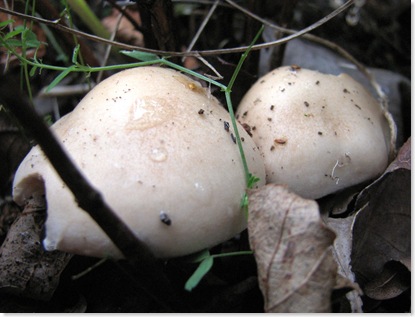
Today I tied up a bit, taking away some of the dead stalks of the all-embracing hairy tare.  Underneath there were, as usual, some unexpected things.  Earlier in the year I found some poison pie toadstools (Hebeloma crustuliniforme) - see below - identified by the mycologist Martin Allison. 
20111004 Wbx Hebeloma crustuliniforme 2

As the name suggest, they can give you very bad indigestion.

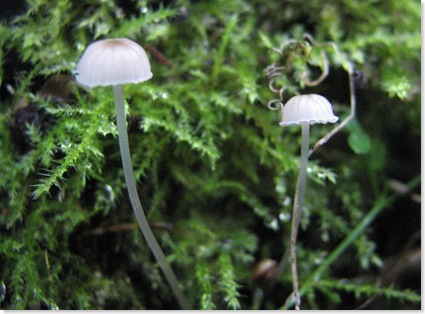
Yesterday there were a couple of very small Marasmius on the mossy bark of the sallow log.  They look like the collared parachute, M. rotula, but are maybe too small and therefore possibly M. bulliardii.  (The moss is common feather-moss, Eurhynchium praelongum.)
20111105 Wbx Marasmius rotula or bulliardii

I also discovered several ivy (Hedera helix) seedlings and one of holly, possibly the garden Highclere holly, Ilex x altaclerensis, rather than our native      I. aquifolium.  I will leave these species to grow though maybe this will produce some management problems in the future.  There was also much creeping bent, Agrostis stolonifera, another new record, and some other developing toadstools, lots of them, that may be honey fungus.  So half a dozen new records: not a bad start to the 7th year.

More on all this tomorrow.

Tuesday, April 05, 2011

Spring arrives 2011

The window box looks very brisk and fresh now that the warmer weather is here.  Everything seems to have survived being frozen solid for some time and there is clearly sufficient nutrient, without my adding anything, to keep the plants healthy

20110404 Pilgrims Rest & WBX 008

There is a surprising number of plants in the view above: dandelion, hairy tare, goosegrass, tutsan, wild service, Druce's cranesbill, herb robert, a grass (probably rough meadow grass), smooth hawksbeard.

The dandelion, which is now some years old, is amazing.

20110404 Pilgrims Rest & WBX 013

Friday, November 19, 2010

A crop of toadstools

In the pouring rain of a grey mid-November day I noticed, through our French windows, some toadstools growing in Wbx.  On closer inspection in better weather conditions next day, they were clearly one of the smaller Coprinus but overnight had started to autodigest around the edges into the inky black liquid characteristic of this genus.

20101119 WBX Coprinus 001

In all I counted about ten fruiting bodies in different places, so the mycelium must spread widely through the window box soil.

Thursday, November 04, 2010

Fifth birthday for this project

The window box has now been going for five years and all the plants appear to be doing remarkably well.  This is particularly surprising as I have given the soil no fertiliser and it must be getting some extra punch from the nitrogen fixing clover and tares and maybe from nitrogen in the rain water or tap water which I apply to the box in dry weather.

Today I coppiced back all the woody species - the sallows, the Himalayan honeysuckle and the tutsan.  The goat willow (Salix caprea) had one stem that had grown exactly five feet (1.52 metres) from the stool since it started this spring.

The two pictures below show the before and after situation.

20101104 Wbx 002

20101104 Wbx 008

Some of the leaves on the goat willow had some small, tent-like leaf mines between the veins and I am pretty sure these are made by the larvae of a micro moth, the long-streaked midget (Phyllonorycter salicicolella), though I may have to wait for a spring hatching of the adult moths to be absolutely sure.

20101104 Wbx 009

As well as a new insect record, I found a new plant for the window box - a young goosegrass (Galium aparine).  There's life in the old box yet, although the plastic gets increasingly fragile.

20101104 Wbx 005

My final picture is of berries on the Himalayan honeysuckle, appropriate for this "season of mists and mellow fruitfulness."

20101029 BHW SV & more 016

Wednesday, August 04, 2010

New flower, new spider-hunting wasp

The plant of Himalayan honeysuckle (Leycesteria formosa)  first recorded in the window box in 2006 is carrying its first flowers.

20100804 Wbx & South View 013

These flowers dangling from red bracts are followed by berries that, by all accounts, are edible so I might be able to harvest my first Wbx crop in a few weeks time.

While photographing this I noticed a small, black spider-hunting wasp sitting on a Wbx tutsan leaf.

20100804 Wbx & South View 021

This is Anoplius nigerrimus, a common species here but one that scarcely ever stays still long enough to get a decent photo.  This one was very obliging and seemed to be taking an unusually long rest on the leaf.  Later though I saw it restlessly hunting for spiders with its usual agitated, questing character.

Monday, August 02, 2010

Different sallows

There are four self-sown sallow willows in the window box, all of which have been there for several years and are coppiced each winter.

They all differ quite markedly in leaf size and shape.

Wbx Sallow leaves 20100802

Top left is, I think, undoubtedly rusty sallow (Salix cinerea ssp. oleifolia), a common and widespread species in Britain, while the large leaf beneath is goat willow (Salix caprea), also common.  The two on the right are probably Salix x reichardtii, hybrids between the first two species, also common.

Detailed accounts of all these species are given in BSBI Handbook No 4, Willows and Poplars of Great Britain and Ireland by R. D. Meikle (1984).

Saturday, June 26, 2010

Tutsan caterpillars

Some of the leaves of the Wbx tutsan (Hypericum androsaemum) have been rolled up by small green caterpillars.

20100626 Wbx tutsan caterpillar 006

I suspect they are one of the omnivorous micromoths, but they could be the  greater purple flat-body (Agonopterix liturosa),an Oecophorid moth .  I'll have to see if I can rear one to adulthood.

In the picture above you can just see the tail of the caterpillar sticking out at the stem end of the leaf.  Below, looking down the tube, you can see its head.

20100626 Wbx tutsan caterpillar 003

Monday, June 21, 2010

Midsummer box

Today is the formal start of summer and the box is looking quite pleased with itself.

20100621 WBX 002

For some time it has been against the east wall of the house from where my wife, Cynthia, can see it, hence the grape vine leaves in the background.

The white clover now covers most of the ground and is flowering.  The tutsan on the right is doing well as is the Leycesteria towards the left.  The reddish leaves are of herb robert which is now coming towards the end of its annual cycle.

It is good to see the box doing so well after last winter when it was frozen solid for weeks.

Wednesday, November 04, 2009

Year five begins

This window box project was started on 4 November 2005, so today we are entering the fifth year.

20091104 Wbx 003

Over that period the box has travelled to Islay in Scotland and Bill Oddy's garden in Hampstead; it has featured in many magazines and papers and has given me a great deal of pleasure and interest.

There is no reason why it should not go on for many more years, though the plastic seems gradually to be getting more brittle and breaking down. I hope, however, to find something into which it can fit lock, stock and barrel.

Today I collected four insect species by sweep netting over the box: a bark fly (Ectopsocus petersi), the springtail Entomobrya nivalis and two flies - Lyciella rorida and Geomyza balachowskyi. The Ectopsocus and the Geomyza are both new records for the project.

The biggest surprise though was a fine crop of toadstools around the base of the rush plant.

20091104 Wbx 006

They are, I think, glistening ink-caps (Coprinellus micaceus) perhaps using the underground part of the sallow log as a medium on which to grow, though they seem to be more associated with the decaying materials at the base of the rush

Wednesday, September 02, 2009

Rabbit revealed

For some time plants in the window box have been somewhat bitten down.  Mainly it seems to be the leaves of the white clover that disappear, but something has chomped at one of the sallow bushes.

At first I discounted rabbits as it seemed much too difficult for these animals to climb up onto the wire crates that keep the top of the window box up to about waist height.

I have, however, caught the culprit in the act and it is indeed one of our bolder lawn rabbits.  This is one record I had not really expected - I hope this bold Brer does not feel inclined to make a burrow.

20090902 South View EVT etc 004a

I am quite happy to let the creature have as much of the clover as it wants and we will have to see about the long term effect.  Meanwhile I reckon I have one of the few window boxes in the world that boasts a wild rabbit visitor.

20090824 Wbx & rabbit2

Thursday, July 23, 2009

Sallow Muppet

The leaf-cutting bees have been at work on the leaves of one of the sallows.

20090723 South View Wbx Swallowtail 002

This example strikes me as having a curiously Muppet-like appearance.

Thursday, June 18, 2009

Late spring apogee

The window box is just going over from a kind of aesthetic apogee that so often happens in nature during the run up to midsummer. Everything is fresh and bright with a bit more growing to do before the dustiness of summer and the first hints of autumn start to appear.

20090617 South View 005

At the southern end of the box the tutsan (Hypericum androsaemum) has flowered and a faded one is now forming a red berry that will soon turn black. Around and about the tutsan are half a dozen flowers of white clover that attract the occasional bumble bee. Hairy tare (Vicia hirsuta) pruned so drastically a few weeks ago has sent more delicate vines up to the light and their tiny mauve-white flowers thrust boldly forwards on long pedicels, challenging the variable breezes.

At the northern end of Wbx, a place that could now perhaps be called a copse, this year’s goat willow wands are one third of a metre high as are the new shoots of the Himalayan honeysuckle. The grey sallows are not so fast but look in good health.

The soft rush is just coming into flower and, deep in the foliage, the filigree leaves of herb robert are gathering strength for the plants that will make a bigger showing in autumn or next spring.

Friday, May 08, 2009

Bullfinches and vetch mulch

I am quite proud of the above post title - slightly reminiscent of Shakespeare's "Like as the waves make towards the pebbl'd shore", though I was not, of course, planning to emulate the sound of breaking surf.

Some have thought though that Shakespeare was acknowledging Ovid who in Metamorphosis XV wrote:

sed ut unda inpellitur urgeturque prior veniente urgetque priorem

Anyway, enough of that. The other day a male bullfinch perched by Wbx and, I am sure, flew over the window box.

20090505 South View WBX 002

A somewhat misty picture as it was taken through our not-recently-cleaned sitting room window.

These beautiful little birds pass through our garden once or twice a year searching for seeds and buds. Sadly they are now of the RSPB's Red List - the highest conservation priority, with species needing urgent action. To quote from Shakespeare's sonnets once again:

From fairest creatures we desire increase,

That thereby beauty's rose might never die

So, on to the second part of my title, the vetch mulch. This is simply that I took the quarter pound of hairy tare I gathered from Wbx the other day, dried it and crumbled it as a light mulch over the upper surface of the box, brushing it down to soil level between the plants. By such actions I hope to build up the shrinking soil a bit, or at least to stop it declining so rapidly.

Sunday, May 03, 2009

Management decision

The hairy tare of last year has seeded itself quite liberally and over the last few weeks and has been growing with great vigour.  It rapidly smothers other plants and its weight is so great that it pulls them down to the ground.

 20090502 WBX   Hairy tare 005

So, I decided to remove the plants and give more space for the other things to develop.  The results are depicted below.

20090502 WBX - Hairy tare 044

I kept the tare arisings and weighed them indoors: 100gm (approx. 4 oz).  I have put it out to dry as hay and may then crumble it up to return to WBX.

Sunday, March 01, 2009

The little things in life

On St David's day I found this tiny springtail, Entomobrya nivalis, sunbathing on the edge of the window box.

20090301 Metre & Ice House 001

Also, on top of the central sallow log I found a few strands of moss emerging from the cracks.

20090228a Wbx moss b

I reflected that this project is in the spirit of St David's last words when he told his brothers and sisters to be joyful and "do the little things in life" (Gwnewch y pethau bychain mewn bywyd in Welsh, his native language)

Tuesday, December 23, 2008

A Wealden wood

With its complement of fallen leaves lying on the moss and the various plants arrayed around within the window box, I noted that it now looks very much like a small rectangle of Wealden woodland floor.

This is not surprising as this is exactly what the area where the window box is situated would have been before the land was cleared by human activity.

20081221 Wbx at midwinter 001

I feel quite pleased as it would be almost impossible, or very difficult to produce such an effect quickly and deliberately.

The photo was taken on 21 December 2008.

Thursday, November 20, 2008

Target leaf-spot fungus on clover

20081120 Wbx clover fungus 004

Some of the leaves of the white clover (Trifolium pratense) has developed target leaf-spot fungi, probably, I think, Stemphylium sarciniforme (there are many leaf spotting fungi found on clovers and they all look very similar unless studied under a high power microscope).

They are called 'target fungi' because they tend to make target-like concentric rings on the leaf.